

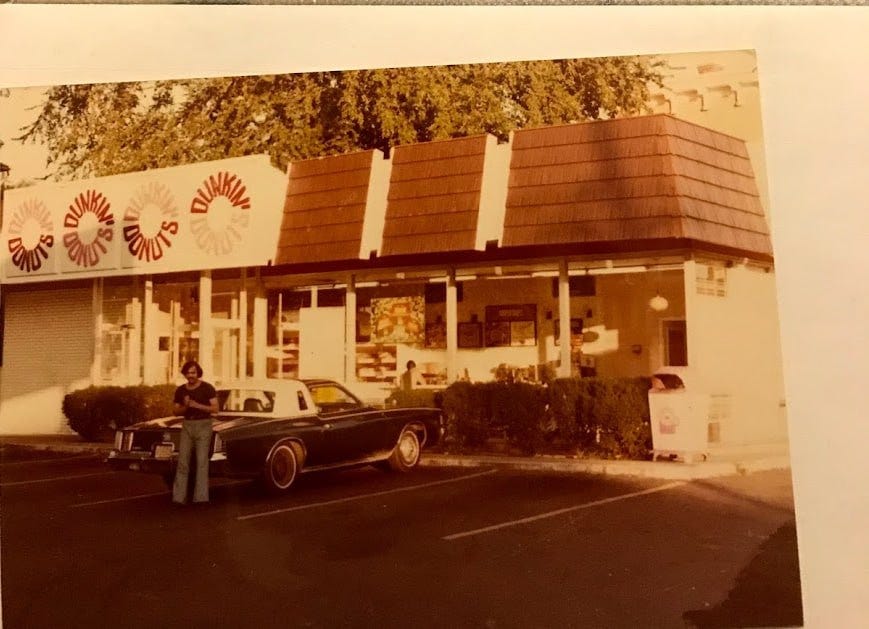
Like the familiar story of so many immigrants, my father moved to the United States in April 1978 at 24 years old with his life savings of a few hundred dollars and the hope of building a better life. To be specific, he moved to New York City.
Despite growing up in poverty in Pakistan, he had managed to create what you could call a middle-class life for himself there, working at a bank. He never bought into the stories about the streets in America being paved with gold, which was very much something people believed then. He simply knew that when it came to opportunity, this was where he needed to be.
Making it here was another story. He worked in convenience stores. He became a manager at Dunkin’ Donuts. He drove a cab. He worked at Popeyes. He did whatever it took to start saving enough money to one day become his own boss. And eventually, that’s exactly what he did.
When I was born, he was still driving a cab. My mother has told me many times that having a baby made her increasingly uncomfortable with him being out at all hours of the night, so she eventually forced him to quit. That’s how my father ended up working at Popeyes.
Over time, he and my mother saved enough that many of my childhood memories are of the different businesses my father tried his hand at. There were dry cleaners and restaurants. There was a parking lot that finally helped him earn enough money to buy us a home in the suburbs. Later, there was a car wash that was unfortunately stolen from him by a bad business partner while he was sick. Some things worked. Others didn’t. But he kept trying.
Today, my siblings and I have a home in one of the wealthiest counties in the United States, here on Long Island, New York. We went on to attend prestigious universities, earn undergraduate and graduate degrees, and build successful professional careers in our own ways. My father passed away in March 2022, but he lived long enough to see what all of that work had made possible for his family.
In nearly every imaginable way, my parents achieved what we call the American Dream. They didn’t come from wealth. They didn’t arrive with connections or resources. What my father had was his willingness to work and the belief that America would give him the opportunity to turn that work into something more, not only for himself, but for his family.
That’s what I believe the American Dream really is. It isn’t a guarantee of success. It’s the idea that people can come here, take risks, build things and create value, and that some of that value will inevitably spread outward through jobs, families, communities and the economy as a whole. My father wasn’t promised that his dry cleaner would succeed, that his restaurant would work or that his parking lot would make enough money to buy a house. America gave him the opportunity to try.
Nearly half a century after he arrived, I’m trying too. Like my father, I’m an entrepreneur. I’m a multi-time founder in the digital asset industry. Despite my mother’s misgivings, and despite having earned the degrees to pursue medicine, I didn’t go to medical school. Today, I run a company called Miden.
To put it plainly, we’re building new financial infrastructure designed to make it easier for people and institutions to move money around the world privately and compliantly. We’re backed by some of the world’s most notable investors and are building a real business. But there’s one major difference between the businesses my father built and the one I’m building today.
When my father opened a parking lot, there were rules he had to follow. Imagine telling him that the government couldn’t clearly explain those rules to him. Imagine telling him to open the business anyway, invest his savings, hire people and operate it, knowing that years later the government might decide that he had violated a rule it had never clearly articulated in the first place. You’d probably say that was ridiculous.
Yet that’s uncomfortably close to the predicament entrepreneurs in the digital asset industry have faced in the United States. Technology that could eventually underpin everything from everyday credit and lending markets to interbank settlements obviously should have rules around it. I want rules around it. Our industry is often accused of wanting to operate without them, but I strongly believe entrepreneurs should have a framework they can follow to know that what they’re building and how they’re operating is legal.
The problem is that the United States still lacks a comprehensive federal market structure for digital assets that resolves some of the industry’s most fundamental questions. We’ve made progress. Last year, the GENIUS Act was signed into law, establishing a regulatory framework for payment stablecoins and creating rules around who can issue them, how they must be backed and how they’re supervised. That was a major step forward.
CLARITY is an attempt to answer another set of basic questions the industry has spent years asking: When is a digital asset treated as a security and when is it treated as a commodity? Which regulator has jurisdiction? What rules govern intermediaries? And what does a company actually have to do to operate legally in the United States?
That’s not to say the legislation is perfect. There are legitimate disagreements around it. There should be. So debate it. Amend it. Improve it. But give American entrepreneurs rules.
We’re fortunate today to have an SEC that is engaging with the industry and working toward clearer guidelines. The previous administration took a much more enforcement-driven approach, leaving companies to interpret regulatory boundaries while facing the possibility that regulators could later tell them they had gotten those boundaries wrong. That’s exactly why legislation matters.
If entrepreneurs’ ability to build in America depends on who happens to occupy the SEC chair, then entrepreneurs don’t actually have regulatory clarity. Administrations change. Agency leadership changes. Entrepreneurs making decisions about where to spend the next decade building a company need something more durable than that.
And builders won’t stop building. They may just stop building here. This is an industry being courted by governments around the world because they understand the economic value that can come from becoming a center for it. Europe has MiCA, creating a harmonized regulatory framework for crypto assets across the European Union. The UAE has deliberately developed regulatory regimes for digital assets. Financial centers around the world have recognized something the United States cannot afford to ignore: regulatory clarity itself can be an economic development tool. Capital can move. Talent can move. Companies can move.
My father understood that better than most. He made a geographic decision based on opportunity. Entrepreneurs today have that same choice. And while America never promised my father that he would succeed, it gave him the opportunity to try. I’m asking for the same thing: tell me the rules under which I’m allowed to try.
My father was 24 years old when he had to decide where he believed his future could be built. He chose America. Somewhere today, another 24-year-old entrepreneur is making their own version of that decision. Maybe they’re in Pakistan. Maybe Nigeria. Argentina. France. Kazakhstan. Wherever they are, they have an idea. They have ambition. And they’re deciding where in the world to build it.
Will they choose America? The American Dream needs CLARITY.